Past Year QuestionsIPMAT Indore2019MCQ

IPMAT Indore 2019MCQ

All 40 MCQ previous year questions (PYQs) from the IPMAT Indore 2019 past year paper, with answers and full solutions.

Free SolutionsNo Login40 Questions
Q1:ipmat indore 2019QASimple & Compound InterestEasyMCQ · MCQ
If the compound interest earned on a certain sum for 2 years is twice the amount of simple interest for 2 years, then the rate of interest per annum is _______ percent
  • A200%
  • B2%
  • C4%
  • D400%
Pick an option to attempt
The Setup: Let's speedrun this finance glitch. Compound interest beats simple interest only because of interest earned *on* the first year's interest - so demanding that CI be exactly twice SI is a very aggressive ask, and the rate it forces is correspondingly extreme. Step 1: Define the base formulas. Let PP be the principal and rr the annual rate as a decimal. SI=Pr2=2Pr,CI=P(1+r)2PSI=P\cdot r\cdot 2=2Pr, \qquad CI=P(1+r)^2-P Step 2: Equate and expand. The condition is CI=2×SICI=2\times SI: P(1+r)2P=2(2Pr)P(1+r)^2-P=2(2Pr) Divide through by PP (a principal of zero is meaningless) and expand: 1+2r+r21=4r    r2+2r=4r1+2r+r^2-1=4r \implies r^2+2r=4r Step 3: Solve for the rate. r22r=0    r(r2)=0r^2-2r=0 \implies r(r-2)=0 The root r=0r=0 would mean no interest at all, making CI=SI=0CI=SI=0 - technically satisfying the equation but describing no loan. Discard it, leaving r=2r=2 as a decimal, i.e. 200%200\%. Step 4: Sanity-check, because 200% looks absurd. Take P=100P=100 at r=200%r=200\%: * Simple interest: 100×2×2=400100\times 2\times 2=400 * Compound: 100(1+2)2100=900100=800100(1+2)^2-100=900-100=800 And 800=2×400800=2\times 400 exactly. The answer really is 200% - the reason it feels wrong is that doubling CI relative to SI is a far harsher demand than it sounds, and only a triple-per-year growth factor achieves it. Option 2 is the trap: solve correctly, get r=2r=2, and then read that 2 as a percentage instead of as the decimal it is. Final Answer: 200%
Q2:ipmat indore 2019QAFactorisationEasyMCQ · MCQ
The maximum value of the natural number nn for which 21n21^n divides 50!50! is
  • A6
  • B7
  • C8
  • D9
Pick an option to attempt
The Setup: Factorials scale up like a boss-level mob. To count how many times 2121 divides 50!50!, break 21 into primes and count each prime's supply separately - whichever runs out first is the bottleneck. Step 1: Prime factorise the base. 21=3×721=3\times 7 Each copy of 21 consumes one 3 and one 7, so 21n21^n needs nn of each. Step 2: Count the supply of each prime with Legendre's formula. The exponent of a prime pp in n!n! is i1npi\sum_{i\geq 1}\left\lfloor\frac{n}{p^i}\right\rfloor. E7(50!)=507+5049=7+1=8E_7(50!)=\left\lfloor\frac{50}{7}\right\rfloor+\left\lfloor\frac{50}{49}\right\rfloor=7+1=8 E3(50!)=503+509+5027=16+5+1=22E_3(50!)=\left\lfloor\frac{50}{3}\right\rfloor+\left\lfloor\frac{50}{9}\right\rfloor+\left\lfloor\frac{50}{27}\right\rfloor=16+5+1=22 Step 3: Take the minimum. The larger prime really is the scarcer one, and that is a theorem rather than a guess: for primes p<qp<q we have pi<qip^i<q^i, so npinqi\left\lfloor\frac{n}{p^i}\right\rfloor\geq\left\lfloor\frac{n}{q^i}\right\rfloor term by term, and summing gives Ep(n!)Eq(n!)E_p(n!)\geq E_q(n!). Still, computing both counts is worth the ten seconds - it turns a general principle into the concrete numbers the answer needs: n=min(E3, E7)=min(22, 8)=8n=\min\left(E_3,\ E_7\right)=\min(22,\ 8)=8 With 22 threes available and only 8 sevens, the sevens are exhausted first - we can assemble 8 copies of 21, and the 14 spare threes are useless without partners. Final Answer: 8
Q3:ipmat indore 2019QARemainderMediumMCQ · MCQ
The remainder when (2929)29(29^{29})^{29} is divided by 99 is
  • A1
  • B2
  • C3
  • D4
Pick an option to attempt
The Setup: Modular arithmetic is overpowered for shrinking absurd numbers. Rather than computing a skyscraper of digits, reduce the base mod 9 and exploit the fact that its powers cycle. Step 1: Read the exponent tower correctly. This is the first trap: (2929)29\left(29^{29}\right)^{29} has brackets, so the exponents multiply: (2929)29=2929×29=29841\left(29^{29}\right)^{29}=29^{29\times 29}=29^{841} This is emphatically not 29(2929)29^{\left(29^{29}\right)}, which would be an astronomically larger number. When the tower is bracketed from the bottom, multiply. Step 2: Simplify the base modulo 9. Since 29=27+229=27+2 and 2727 is a multiple of 9: 292(mod9)29\equiv 2\pmod 9 So the task reduces to finding 2841mod92^{841}\bmod 9. Step 3: Find the cycle. List powers of 2 modulo 9 until they repeat: 212,224,238,247,255,2612^1\equiv 2,\quad 2^2\equiv 4,\quad 2^3\equiv 8,\quad 2^4\equiv 7,\quad 2^5\equiv 5,\quad 2^6\equiv 1 Hitting 1 at the sixth power means the cycle length is exactly 6, consistent with ϕ(9)=6\phi(9)=6. Step 4: Reduce the exponent modulo the cycle length. 841=6×140+1    8411(mod6)841=6\times 140+1 \implies 841\equiv 1\pmod 6 So 28412^{841} sits at the same position in the cycle as 212^1: 2841212(mod9)2^{841}\equiv 2^1\equiv 2\pmod 9 Final Answer: 2
Q4:ipmat indore 2019QADivisibility RulesEasyMCQ · MCQ
Placing which of the following two digits at the right end of 45304530 makes the resultant six digit number divisible by 6,76, 7 and 99:
  • A96
  • B78
  • C42
  • D54
Pick an option to attempt
The Setup: Rather than running three separate divisibility side quests, fuse them into one by taking the LCM - a number divisible by 6, 7 and 9 is exactly a number divisible by their least common multiple. Step 1: Find the master divisor. Factorising: 6=2×36=2\times 3, 7=77=7, 9=329=3^2. The LCM takes the highest power of each prime: LCM(6,7,9)=2×32×7=126\text{LCM}(6,7,9)=2\times 3^2\times 7=126 Note it is not 6×7×9=3786\times 7\times 9=378 - 6 and 9 share a factor of 3, so the product over-counts. Step 2: Build the number. Appending two digits to 4530 gives 453000+x453000+x, where xx runs from 00 to 99. Step 3: Find the gap. Divide the base by 126: 453000=126×3595+30453000=126\times 3595+30 The base overshoots a multiple of 126 by 30, so to reach the next one we must add: 12630=96126-30=96 That gives 453096=126×3596453096=126\times 3596. And since the following candidate would be 96+126=22296+126=222 - far beyond two digits - 96 is the only possible answer in range, which is worth noting rather than stopping at the first hit. Step 4: Confirm the distractors fail. All three wrong options clear the divisibility by 6, so that test alone separates nothing - 78 and 42 both fall at the 7, and 54 falls at the 9:
AppendedNumberby 6by 7by 9
96453096yesyesyes
78453078yesnoyes
42453042yesnoyes
54453054yesyesno
Final Answer: 96
Q5:ipmat indore 2019QASet TheoryEasyMCQ · MCQ
In a school 70%70\% of the boys like cricket and 50%50\% like football. If x%x\% like both Cricket and Football, then
  • A20x5020 \leq x \leq 50
  • Bx20x \leq 20
  • Cx50x \geq 50
  • D10x7010 \leq x \leq 70
Pick an option to attempt
The Setup: Two overlapping sets, and we need the floor and ceiling on the overlap xx. Both bounds come from hard constraints, not from assumptions about the school. Step 1: The ceiling. An intersection can never exceed either of the sets forming it. Only 50% like football, and everyone who likes both is among them: xmin(70, 50)=50x\leq\min(70,\ 50)=50 Step 2: The floor - derived, not assumed. The union of the two groups cannot exceed the whole school, so n(CF)100n(C\cup F)\leq 100. By inclusion-exclusion: n(CF)=70+50x=120xn(C\cup F)=70+50-x=120-x Combining the two: 120x100    x20120-x\leq 100 \implies x\geq 20 This is worth stating as an inequality rather than as *suppose everyone likes at least one sport*. That supposition is only the extreme case; the real reason xx cannot drop below 20 is that 70 and 50 together already claim 120 percentage points of a 100-point school, so at least 20 points must be double-counted. The overlap is forced by arithmetic, whether or not anyone likes neither sport. Step 3: Combine. Both bounds are attainable - x=50x=50 when every football fan also likes cricket, and x=20x=20 when the two groups spread across the whole school with nobody left out: 20x5020\leq x\leq 50 Final Answer: 20x5020 \leq x \leq 50
Q6:ipmat indore 2019QASet TheoryMediumMCQ · MCQ
In a class of 65 students 40 like cricket, 25 like football and 20 like hockey. 10 students like both cricket and football, 8 students like football and hockey and 5 students like all three sports. If all the students like at least one sport, then the number of students who like both cricket and hockey is
  • A7
  • B8
  • C10
  • D12
Pick an option to attempt
The Setup: A triple-set problem where the union is handed to us - every one of the 65 students likes at least one sport - so inclusion-exclusion has exactly one unknown and can simply be solved. Step 1: The master formula. With CC, FF, HH for cricket, football and hockey: n(CFH)=n(C)+n(F)+n(H)n(CF)n(FH)n(CH)+n(CFH)n(C\cup F\cup H)=n(C)+n(F)+n(H)-n(C\cap F)-n(F\cap H)-n(C\cap H)+n(C\cap F\cap H) Step 2: Substitute. Since every student likes at least one sport, the union is the full class of 65. Let y=n(CH)y=n(C\cap H): 65=40+25+20108y+565=40+25+20-10-8-y+5 Step 3: Solve. 65=8518+5y=72y    y=7265=765=85-18+5-y=72-y \implies y=72-65=7 Step 4: Verify the Venn diagram is actually consistent. A value that satisfies the equation can still be nonsense if it forces a negative region, so break the class into its seven disjoint parts. Subtracting the triple overlap of 5 from each pair:
RegionCount
All three5
Cricket & football only105=510-5=5
Football & hockey only85=38-5=3
Cricket & hockey only75=27-5=2
Cricket only40552=2840-5-5-2=28
Football only25553=1225-5-5-3=12
Hockey only20532=1020-5-3-2=10
Every region is non-negative, and they total 5+5+3+2+28+12+10=655+5+3+2+28+12+10=65 - exactly the class size. The answer is not just algebraically valid but genuinely realisable. Final Answer: 7
Q7:ipmat indore 2019QAInequalitiesHardMCQ · MCQ
If x(a,b)x \in (a, b) satisfies the inequality x3x2+3x+21\dfrac{x - 3}{x^2 + 3x + 2} \geq 1, then the largest possible value of bab - a is
  • A3
  • B1
  • C2
  • DNo real values of x satisfies the inequality
Pick an option to attempt
The Setup: A rational inequality. We cannot cross-multiply, because the denominator's sign is unknown and multiplying by a negative would flip the inequality. Everything goes to one side instead. Step 1: Reframe. Move the 1 across and combine over a common denominator: x3x2+3x+210    x3(x2+3x+2)x2+3x+20    x22x5x2+3x+20\frac{x-3}{x^2+3x+2}-1\geq 0 \implies \frac{x-3-\left(x^2+3x+2\right)}{x^2+3x+2}\geq 0 \implies \frac{-x^2-2x-5}{x^2+3x+2}\geq 0 Step 2: Kill the numerator's sign ambiguity. Multiply by 1-1 and reverse the inequality: x2+2x+5x2+3x+20\frac{x^2+2x+5}{x^2+3x+2}\leq 0 Check the numerator's discriminant: Δ=224(1)(5)=420=16<0\Delta=2^2-4(1)(5)=4-20=-16<0 With Δ<0\Delta<0 and a positive leading coefficient, x2+2x+5x^2+2x+5 is **strictly positive for every real xx - it never touches zero. So the numerator can never make the fraction zero or negative on its own. Step 3: Force the denominator negative.** A positive over something, being 0\leq 0, requires the denominator to be strictly negative (zero is not allowed - the expression would be undefined): (x+1)(x+2)<0(x+1)(x+2)<0 An upward parabola sits below zero strictly between its roots: x(2,1)x\in(-2,-1) Note the interval is open because the endpoints 2-2 and 1-1 make the denominator zero, where the original expression is undefined. Separately worth seeing: the numerator x2+2x+5x^2+2x+5 never vanishes, so the fraction is never exactly zero - meaning equality in the original 1\geq 1 is never attained, and the condition behaves throughout as a strict >1>1. Step 4: Compute the width. With a=2a=-2 and b=1b=-1: ba=1(2)=1b-a=-1-(-2)=1 Option 4 - claiming no real xx works - is the trap for anyone who mishandles the sign flip in Step 2 and concludes the fraction can never be negative. Final Answer: 1
Q8:ipmat indore 2019QAIdentitiesHardMCQ · MCQ
If a,b,ca, b, c are real numbers and a2+b2+c2=1a^2 + b^2 + c^2 = 1, then the set of values ab+bc+caab + bc + ca can take is:
  • A[-1,2]
  • B[-12\frac{1}{2}, 2]
  • C[-1,1]
  • D[-12\frac{1}{2}, 1]
Pick an option to attempt
The Setup: We need the exact range of ab+bc+caab+bc+ca on the unit sphere a2+b2+c2=1a^2+b^2+c^2=1. Both bounds fall out of the fact that a real square is never negative - but a bound is only the answer if it is actually reached, so we must exhibit a witness for each. Step 1: The lower bound. Expand a perfect square, which cannot be negative: (a+b+c)20    a2+b2+c2+2(ab+bc+ca)0(a+b+c)^2\geq 0 \implies a^2+b^2+c^2+2(ab+bc+ca)\geq 0 Substituting the constraint: 1+2(ab+bc+ca)0    ab+bc+ca121+2(ab+bc+ca)\geq 0 \implies ab+bc+ca\geq -\frac{1}{2} Step 2: The upper bound. Use the sum of pairwise squared differences, also non-negative: (ab)2+(bc)2+(ca)20    2(a2+b2+c2)2(ab+bc+ca)0(a-b)^2+(b-c)^2+(c-a)^2\geq 0 \implies 2\left(a^2+b^2+c^2\right)-2(ab+bc+ca)\geq 0 2(1)2(ab+bc+ca)0    ab+bc+ca12(1)-2(ab+bc+ca)\geq 0 \implies ab+bc+ca\leq 1 Step 3: Show both ends are attained. Inequalities alone would allow a smaller range, so produce explicit points on the sphere: * Upper: take a=b=c=13a=b=c=\frac{1}{\sqrt{3}}. Then a2+b2+c2=313=1a^2+b^2+c^2=3\cdot\frac{1}{3}=1 ✓, and ab+bc+ca=313=1ab+bc+ca=3\cdot\frac{1}{3}=1. Equality holds because (ab)2+(bc)2+(ca)2=0(a-b)^2+(b-c)^2+(c-a)^2=0 exactly when all three are equal. * Lower: take a=12a=\frac{1}{\sqrt{2}}, b=12b=-\frac{1}{\sqrt{2}}, c=0c=0. Then a2+b2+c2=12+12+0=1a^2+b^2+c^2=\frac{1}{2}+\frac{1}{2}+0=1 ✓, and ab+bc+ca=12+0+0=12ab+bc+ca=-\frac{1}{2}+0+0=-\frac{1}{2}. Equality holds because a+b+c=0a+b+c=0. Step 4: Conclude. The expression is continuous on a connected sphere, so it sweeps every value between the two attained extremes - the set is the closed interval, endpoints included: 12ab+bc+ca1-\frac{1}{2}\leq ab+bc+ca\leq 1 Final Answer: [-12\frac{1}{2}, 1]
Q9:ipmat indore 2019QALogarithmsMediumMCQ · MCQ
The inequality log23x12x<1\log_{2} \frac{3x - 1}{2 - x} < 1 holds true for
  • Ax(13,1)x \in \left( \frac{1}{3}, 1 \right)
  • Bx(13,2)x \in \left( \frac{1}{3}, 2 \right)
  • Cx(0,13)(1,2)x \in \left( 0, \frac{1}{3} \right) \cup \left( 1, 2 \right)
  • Dx(,1)x \in \left( -\infty, 1 \right)
Pick an option to attempt
The Setup: Before touching the inequality we must respect the logarithm's domain. A log of a non-positive number does not exist, so any xx that breaks the argument is disqualified before the inequality is even considered - and skipping this step is exactly how the wrong option gets picked here. Step 1: Determine the domain. The argument must be strictly positive: 3x12x>0\frac{3x-1}{2-x}>0 The critical points are x=13x=\frac{1}{3} (numerator zero) and x=2x=2 (denominator zero). Testing the three regions: for x<13x<\frac{1}{3} the numerator is negative and denominator positive, giving a negative; for 13<x<2\frac{1}{3}<x<2 both are positive; for x>2x>2 the numerator is positive and denominator negative. So: Domain=(13, 2)\text{Domain}=\left(\frac{1}{3},\ 2\right) Step 2: Unpack the inequality. The base is 2>12>1, so the logarithm is increasing and the inequality direction is preserved when exponentiating: 3x12x<21=2\frac{3x-1}{2-x}<2^1=2 Move everything to one side rather than cross-multiplying, since 2x2-x changes sign: 3x12x2<0    3x12(2x)2x<0    5x52x<0\frac{3x-1}{2-x}-2<0 \implies \frac{3x-1-2(2-x)}{2-x}<0 \implies \frac{5x-5}{2-x}<0 Step 3: Solve. Factor and tidy the sign: 5(x1)(x2)<0    x1x2>0\frac{5(x-1)}{-(x-2)}<0 \implies \frac{x-1}{x-2}>0 A quotient is positive when both parts share a sign, giving x<1x<1 or x>2x>2. Step 4: Intersect with the domain - this is where the question is won or lost. [(,1)(2,)](13,2)=(13, 1)\left[(-\infty,1)\cup(2,\infty)\right]\cap\left(\frac{1}{3},2\right)=\left(\frac{1}{3},\ 1\right) The branch x>2x>2 solves the algebra perfectly but lies entirely outside the domain, where the logarithm does not exist at all. Discarding it is not optional bookkeeping: carry it through and the answer set is simply wrong, no matter how clean the algebra behind it looked. Final Answer: x(13,1)x \in \left( \frac{1}{3}, 1 \right)
Q10:ipmat indore 2019QAInequalitiesMediumMCQ · MCQ
The set of values of xx which satisfy the inequality 0.7(2x23x+4)<0.3430.7^{(2x^2 - 3x + 4)} < 0.343 is
  • A(12,1)\left( \frac{1}{2}, 1 \right)
  • B(12,)\left( \frac{1}{2}, \infty \right)
  • C(,12)\left( -\infty, \frac{1}{2} \right)
  • D(,12)(1,)\left( -\infty, \frac{1}{2} \right) \cup \left( 1, \infty \right)
Pick an option to attempt
The Setup: An exponential inequality with a trap built into the base. Because 0.7<10.7<1, the function 0.7t0.7^t is decreasing, so comparing exponents reverses the inequality - an UNO reverse card most people forget to play. Step 1: Match the bases. Since 73=3437^3=343, scaling the decimal places gives: 0.343=(0.7)3    0.7(2x23x+4)<0.730.343=(0.7)^3 \implies 0.7^{\left(2x^2-3x+4\right)}<0.7^3 Step 2: Drop the bases and flip. For a base in (0,1)(0,1), a smaller value corresponds to a larger exponent: 2x23x+4>32x^2-3x+4>3 Step 3: Solve the quadratic inequality. 2x23x+1>02x^2-3x+1>0 Factor by splitting the middle term: 2x22xx+1>0    2x(x1)1(x1)>0    (2x1)(x1)>02x^2-2x-x+1>0 \implies 2x(x-1)-1(x-1)>0 \implies (2x-1)(x-1)>0 The roots are x=12x=\frac{1}{2} and x=1x=1. The leading coefficient is positive, so the parabola opens upward and is positive outside its roots and negative between them. Step 4: Write the interval. x<12orx>1x<\frac{1}{2} \quad\text{or}\quad x>1 Option 1, the interval (12,1)\left(\frac{1}{2},1\right), is precisely what you get by not flipping the sign in Step 2: that error yields 2x23x+1<02x^2-3x+1<0, whose solution is the region *between* the roots rather than outside them. The whole question turns on that single step. Final Answer: (,12)(1,)\left( -\infty, \frac{1}{2} \right) \cup \left( 1, \infty \right)
Q11:ipmat indore 2019QACirclesHardMCQ · MCQ
A chord is drawn inside a circle, such that the length of the chord is equal to the radius of the circle. Now, two circles are drawn, one on each side of the chord, each touching the chord at its midpoint and the original circle. Let k be the ratio of the areas of the bigger inscribed circle and the smaller inscribed circle, then k equals
  • A2+32 + \sqrt{3}
  • B1+21 + \sqrt{2}
  • C7+437 + 4\sqrt{3}
  • D97+56397 + 56\sqrt{3}
Pick an option to attempt
The Setup: Pure equilateral-triangle energy. With the chord equal to the radius, joining the centre to the chord's endpoints makes an equilateral triangle, which hands us the centre-to-chord distance. From there the two inscribed circles are pinned down exactly. Step 1: Find the distance to the chord. Take R=1R=1 to keep the arithmetic light. A chord of length 1 subtends an equilateral triangle with the centre, and the perpendicular distance from centre to chord is that triangle's height: d=R2(R2)2=114=32d=\sqrt{R^2-\left(\frac{R}{2}\right)^2}=\sqrt{1-\frac{1}{4}}=\frac{\sqrt{3}}{2} Step 2: Pin down each inscribed circle - this is the load-bearing step. Put the centre OO at the origin with the chord horizontal at height dd, so its midpoint is M=(0,32)M=\left(0,\tfrac{\sqrt{3}}{2}\right) and the perpendicular through MM is the yy-axis. A circle touching the chord **at MM** must have its centre on that perpendicular, at distance rr from MM. * Above the chord (away from OO): centre (0,d+r)\left(0,d+r\right). Internal tangency to the big circle means the centres are RrR-r apart, so d+r=Rrd+r=R-r, giving 2r=Rd2r=R-d - its **diameter is RdR-d**. * Below the chord (past OO): centre (0,dr)\left(0,d-r\right) with r>dr>d, so the distance to OO is rdr-d, and internal tangency gives rd=Rrr-d=R-r, i.e. 2r=R+d2r=R+d - its **diameter is R+dR+d**. So the two circles have as diameters exactly the two pieces into which MM cuts the vertical diameter of the original circle, running from MM up to (0,1)(0,1) and from MM down to (0,1)(0,-1): smaller=132,bigger=1+32\text{smaller}=1-\frac{\sqrt{3}}{2}, \qquad \text{bigger}=1+\frac{\sqrt{3}}{2} Step 3: Take the ratio of areas. Areas scale as the square of any linear measure, so the area ratio is the square of the diameter ratio: k=(1+32132)2=(2+323)2k=\left(\frac{1+\frac{\sqrt{3}}{2}}{1-\frac{\sqrt{3}}{2}}\right)^2=\left(\frac{2+\sqrt{3}}{2-\sqrt{3}}\right)^2 Rationalise the inner fraction by multiplying top and bottom by 2+32+\sqrt{3}, noting (23)(2+3)=43=1(2-\sqrt{3})(2+\sqrt{3})=4-3=1: k=((2+3)21)2=(2+3)4k=\left(\frac{(2+\sqrt{3})^2}{1}\right)^2=(2+\sqrt{3})^4 Step 4: Expand in two stages. (2+3)2=4+43+3=7+43(2+\sqrt{3})^2=4+4\sqrt{3}+3=7+4\sqrt{3} k=(7+43)2=49+563+48=97+563k=(7+4\sqrt{3})^2=49+56\sqrt{3}+48=97+56\sqrt{3} Watch the option list: 7+437+4\sqrt{3} is sitting there as option 3, and it is precisely the ratio of the diameters, not the areas. Stopping one squaring too early lands exactly on it. Final Answer: 97+56397 + 56\sqrt{3}
Q12:ipmat indore 2019QAQuadrilateralsMediumMCQ · MCQ
Points PP, QQ, RR, and SS are taken on sides ABAB, BCBC, CDCD, and DADA of square ABCDABCD respectively, so that APPB=BQQC=CRRD=DSSA=1n\frac{AP}{PB} = \frac{BQ}{QC} = \frac{CR}{RD} = \frac{DS}{SA} = \frac{1}{n}. Then the ratio of the area of PQRSPQRS to the area of ABCDABCD is
  • A1:(1+n)1 : (1 + n)
  • B1:n1 : n
  • C1+n2:(1+n)21 + n^2 : (1 + n)^2
  • D(1+n):(1+n2)(1 + n) : (1 + n^2)
Pick an option to attempt
The Setup: A tilted quadrilateral inside a square. Rather than chase the inner side length directly, compute the four corner triangles and subtract them from the whole - the symmetry makes all four identical. Step 1: Define the segments. Let the big square have side xx. The ratio APPB=1n\frac{AP}{PB}=\frac{1}{n} splits each side into 1+n1+n equal parts, one part then nn parts: AP=BQ=CR=DS=xn+1,PB=QC=RD=SA=nxn+1AP=BQ=CR=DS=\frac{x}{n+1}, \qquad PB=QC=RD=SA=\frac{nx}{n+1} Step 2: Compute one corner triangle, then argue the rest. Triangle PBQPBQ sits in corner BB, right-angled there, with legs PBPB and BQBQ: [PBQ]=12nxn+1xn+1=nx22(n+1)2[\,PBQ\,]=\frac{1}{2}\cdot\frac{nx}{n+1}\cdot\frac{x}{n+1}=\frac{nx^2}{2(n+1)^2} The other three are congruent, not merely similar: at corner CC the legs are QC=nxn+1QC=\frac{nx}{n+1} and CR=xn+1CR=\frac{x}{n+1} - the same two lengths, and likewise at DD and AA. The whole configuration maps to itself under a 9090^\circ rotation, so: Total corner area=4×nx22(n+1)2=2nx2(n+1)2\text{Total corner area}=4\times\frac{nx^2}{2(n+1)^2}=\frac{2nx^2}{(n+1)^2} Step 3: Subtract. [PQRS]=x22nx2(n+1)2=x2((n+1)22n(n+1)2)=x2(n2+2n+12n(n+1)2)=x2n2+1(n+1)2[\,PQRS\,]=x^2-\frac{2nx^2}{(n+1)^2}=x^2\left(\frac{(n+1)^2-2n}{(n+1)^2}\right)=x^2\left(\frac{n^2+2n+1-2n}{(n+1)^2}\right)=x^2\cdot\frac{n^2+1}{(n+1)^2} Step 4: Form the ratio. Dividing by [ABCD]=x2[\,ABCD\,]=x^2, the side length cancels entirely - the answer depends only on nn: [PQRS][ABCD]=1+n2(1+n)2\frac{[\,PQRS\,]}{[\,ABCD\,]}=\frac{1+n^2}{(1+n)^2} Sanity check at n=1n=1, where every point is a midpoint: the ratio becomes 24=12\frac{2}{4}=\frac{1}{2}, the well-known result that joining the midpoints of a square halves its area. Final Answer: 1+n2:(1+n)21 + n^2 : (1 + n)^2
Q13:ipmat indore 2019QACirclesHardMCQ · MCQ
On a circular path of radius 6 m a boy starts from a point AA on the circumference and walks along a chord ABAB of length 3 m. He then walks along another chord BCBC of length 2 m to reach point CC. The point BB lies on the minor arc ACAC. The distance between point CC from point AA is
  • A15+352\frac{\sqrt{15} + \sqrt{35}}{2} m
  • B88 m
  • C13\sqrt{13} m
  • D66 m
Pick an option to attempt
The Setup: Two chords laid end to end inside a circle. Each chord subtends a central angle we can extract with the cosine rule, and because BB lies on the minor arc ACAC, those two angles simply add to give the angle subtending ACAC. Step 1: Find each central angle. Let OO be the centre, R=6R=6. Triangle OABOAB has sides 6,6,36,6,3, so with AOB=α\angle AOB=\alpha: cosα=62+62322(6)(6)=72972=6372=78\cos\alpha=\frac{6^2+6^2-3^2}{2(6)(6)}=\frac{72-9}{72}=\frac{63}{72}=\frac{7}{8} Triangle OBCOBC has sides 6,6,26,6,2, so with BOC=β\angle BOC=\beta: cosβ=62+62222(6)(6)=72472=6872=1718\cos\beta=\frac{6^2+6^2-2^2}{2(6)(6)}=\frac{72-4}{72}=\frac{68}{72}=\frac{17}{18} Step 2: Add the angles. Since BB lies on the minor arc ACAC, the two central angles sit side by side without overlapping, so AOC=α+β\angle AOC=\alpha+\beta. Both are central angles in (0,π)(0,\pi), where sine is positive, so we may take the positive root: sinα=14964=158,sinβ=1289324=3518\sin\alpha=\sqrt{1-\frac{49}{64}}=\frac{\sqrt{15}}{8}, \qquad \sin\beta=\sqrt{1-\frac{289}{324}}=\frac{\sqrt{35}}{18} Now the cosine addition formula: cos(α+β)=cosαcosβsinαsinβ=7817181583518=119525144=119521144\cos(\alpha+\beta)=\cos\alpha\cos\beta-\sin\alpha\sin\beta=\frac{7}{8}\cdot\frac{17}{18}-\frac{\sqrt{15}}{8}\cdot\frac{\sqrt{35}}{18}=\frac{119-\sqrt{525}}{144}=\frac{119-5\sqrt{21}}{144} using 525=25×21=521\sqrt{525}=\sqrt{25\times 21}=5\sqrt{21}. **Step 3: Cosine rule once more, on triangle OACOAC.** AC2=62+622(6)(6)cos(α+β)=7272119521144=721195212AC^2=6^2+6^2-2(6)(6)\cos(\alpha+\beta)=72-72\cdot\frac{119-5\sqrt{21}}{144}=72-\frac{119-5\sqrt{21}}{2} AC2=144119+5212=25+5212=50+10214AC^2=\frac{144-119+5\sqrt{21}}{2}=\frac{25+5\sqrt{21}}{2}=\frac{50+10\sqrt{21}}{4} Step 4: Recognise the perfect square. The surd untangles because 50+102150+10\sqrt{21} is a square: (15+35)2=15+35+21535=50+2525=50+1021\left(\sqrt{15}+\sqrt{35}\right)^2=15+35+2\sqrt{15\cdot 35}=50+2\sqrt{525}=50+10\sqrt{21} AC=15+3524.89 mAC=\frac{\sqrt{15}+\sqrt{35}}{2}\approx 4.89\text{ m} A quick plausibility check: ACAC must be less than AB+BC=5AB+BC=5 (triangle inequality) and more than each chord, and 4.894.89 sits exactly there. The distractors fail this outright - 8 m and 6 m both exceed the straight-line distance AB+BC=5AB+BC=5, which is impossible. Final Answer: 15+352\frac{\sqrt{15} + \sqrt{35}}{2} m
Q14:ipmat indore 2019QAModulusEasyMCQ · MCQ
The area enclosed by the curve 2x+3y=62|x| + 3|y| = 6 is
  • A12 square units
  • B3 square units
  • C4 square units
  • D24 square units
Pick an option to attempt
The Setup: Absolute values mirror the graph across both axes, so this curve is a quadrilateral centred at the origin. Find the intercepts, confirm the shape, and the area follows from one formula. Step 1: Find the intercepts. Setting y=0y=0: 2x=6    x=3    x=±32|x|=6 \implies |x|=3 \implies x=\pm 3 Setting x=0x=0: 3y=6    y=2    y=±23|y|=6 \implies |y|=2 \implies y=\pm 2 Step 2: Identify the shape. In each quadrant the equation is linear - for instance 2x+3y=62x+3y=6 when both are positive - so the curve is four straight segments joining (3,0)(3,0), (0,2)(0,2), (3,0)(-3,0) and (0,2)(0,-2). Each side runs between an xx-intercept and a yy-intercept, so every side has length 32+22=13\sqrt{3^2+2^2}=\sqrt{13}: all four equal, making it a genuine rhombus with perpendicular diagonals along the axes. Step 3: Measure the diagonals. d1=3(3)=6,d2=2(2)=4d_1=3-(-3)=6, \qquad d_2=2-(-2)=4 Step 4: Compute the area. For a rhombus (indeed any quadrilateral with perpendicular diagonals), the area is half the product of the diagonals: Area=12d1d2=12(6)(4)=12\text{Area}=\frac{1}{2}d_1d_2=\frac{1}{2}(6)(4)=12 Equivalently, the first-quadrant piece is a right triangle of legs 3 and 2, area 33, and symmetry gives four of them: 4×3=124\times 3=12. Two routes, same number. Final Answer: 12 square units
Q15:ipmat indore 2019QAStraight LinesHardMCQ · MCQ
Two points on a ground are 1 m apart. If a cow moves in the field in such a way that its distance from the two points is always in ratio 3:23: 2 then
  • Athe cow moves in a straight line
  • Bthe cow moves in a circle
  • Cthe cow moves in a parabola
  • Dthe cow moves in a hyperbola
Pick an option to attempt
The Setup: A locus question. When a point moves so that the ratio of its distances to two fixed points stays constant, the path is completely determined by that constant - this is the Circle of Apollonius. Step 1: State the condition. Let the fixed points be AA and BB with AB=1AB=1 m, and let PP be the cow. The condition is: PAPB=32\frac{PA}{PB}=\frac{3}{2} Step 2: Apply the Apollonius result. For PAPB=k\frac{PA}{PB}=k with k>0k>0: * If k=1k=1 the locus is the perpendicular bisector of ABAB - a straight line, since equal distances means equidistant. * If k1k\neq 1 the locus is a circle. Here k=321k=\frac{3}{2}\neq 1, so the cow traces a circle. Step 3: See it concretely rather than just quoting the theorem. Put AA at the origin and BB at (1,0)(1,0), and let P=(x,y)P=(x,y). Then PA2=94PB2PA^2=\tfrac{9}{4}PB^2 gives: 4(x2+y2)=9((x1)2+y2)    5x2+5y218x+9=04\left(x^2+y^2\right)=9\left((x-1)^2+y^2\right) \implies 5x^2+5y^2-18x+9=0 x2+y2185x+95=0    (x95)2+y2=(65)2x^2+y^2-\frac{18}{5}x+\frac{9}{5}=0 \implies \left(x-\frac{9}{5}\right)^2+y^2=\left(\frac{6}{5}\right)^2 That is unmistakably a circle - centre (1.8,0)\left(1.8,\,0\right), radius 1.21.2 m. The two points where it crosses the line ABAB are the internal and external division points of ABAB in the ratio 3:23:2, namely x=0.6x=0.6 and x=3x=3, which is exactly the diameter [0.6,3][0.6,\,3] of width 2.42.4. Note the circle is not centred on ABAB's midpoint and does not pass through AA or BB - a useful check that this really is Apollonius and not the perpendicular bisector. Final Answer: the cow moves in a circle
Q16:ipmat indore 2019QATrigonometryHardMCQ · MCQ
Given that cosx+cosy=1\cos x + \cos y = 1, the range of sinxsiny\sin x - \sin y is
  • A[1,1][-1, 1]
  • B[2,2][-2, 2]
  • C[0,3][0, \sqrt{3}]
  • D[3,3][-\sqrt{3}, \sqrt{3}]
Pick an option to attempt
The Setup: One equation constrains the pair (x,y)(x,y), and we want the range of a second expression. Squaring both and adding is the standard move, because the Pythagorean identity then collapses most of the terms. Step 1: Name the target. Let S=sinxsinyS=\sin x-\sin y, given cosx+cosy=1\cos x+\cos y=1. Step 2: Square both and add. (cosx+cosy)2=1    cos2x+2cosxcosy+cos2y=1(\cos x+\cos y)^2=1 \implies \cos^2x+2\cos x\cos y+\cos^2y=1 (sinxsiny)2=S2    sin2x2sinxsiny+sin2y=S2(\sin x-\sin y)^2=S^2 \implies \sin^2x-2\sin x\sin y+\sin^2y=S^2 Adding, and grouping sin2+cos2=1\sin^2+\cos^2=1 for each of xx and yy: 1+1+2(cosxcosysinxsiny)=1+S21+1+2\left(\cos x\cos y-\sin x\sin y\right)=1+S^2 The bracket is exactly the expansion of cos(x+y)\cos(x+y), so: 2+2cos(x+y)=1+S2    S2=1+2cos(x+y)2+2\cos(x+y)=1+S^2 \implies S^2=1+2\cos(x+y) **Step 3: Bound cos(x+y)\cos(x+y) using the constraint.** Sum-to-product on the given equation, writing u=x+y2u=\frac{x+y}{2} and v=xy2v=\frac{x-y}{2}: 2cosucosv=1    cosucosv=122\cos u\cos v=1 \implies \cos u\cos v=\frac{1}{2} Since cosv1|\cos v|\leq 1, we need cosu12|\cos u|\geq\frac{1}{2}, hence cos2u14\cos^2u\geq\frac{1}{4}. The double-angle formula then gives: cos(x+y)=2cos2u12141=12\cos(x+y)=2\cos^2u-1 \geq 2\cdot\frac{1}{4}-1=-\frac{1}{2} and of course cos(x+y)1\cos(x+y)\leq 1 always. Substituting into S2=1+2cos(x+y)S^2=1+2\cos(x+y): S2[11, 1+2]=[0, 3]S^2\in[\,1-1,\ 1+2\,]=[0,\ 3] Step 4: Confirm both extremes are actually reachable. Bounds are worthless unless attained, so produce explicit angles satisfying cosx+cosy=1\cos x+\cos y=1: * x=π3, y=π3x=\frac{\pi}{3},\ y=-\frac{\pi}{3}: then cosx+cosy=12+12=1\cos x+\cos y=\frac{1}{2}+\frac{1}{2}=1 ✓ and S=32(32)=3S=\frac{\sqrt{3}}{2}-\left(-\frac{\sqrt{3}}{2}\right)=\sqrt{3}, the maximum. * x=y=π3x=y=\frac{\pi}{3}: then cosx+cosy=1\cos x+\cos y=1 ✓ and S=0S=0, the minimum of S|S|. Swapping xx and yy negates SS, so 3-\sqrt{3} is reached too, and since SS varies continuously it sweeps everything between: S[3, 3]S\in\left[-\sqrt{3},\ \sqrt{3}\right] Final Answer: [3,3][-\sqrt{3}, \sqrt{3}]
Q17:ipmat indore 2019QATrigonometryHardMCQ · MCQ
If sinθ+cosθ=msin \theta + cos \theta = m, then sin6θ+cos6θsin^6 \theta + cos^6 \theta equals
  • A3(m2+1)4\frac{3(m^2+1)}{4}
  • B3(m21)4\frac{3(m^2-1)}{4}
  • C13(m21)41-\frac{3(m^2-1)}{4}
  • D13(m21)241-\frac{3(m^2-1)^2}{4}
Pick an option to attempt
The Setup: An algebraic identity wearing a trigonometry costume. We must climb from first powers to sixth powers, and the bridge is the single quantity sinθcosθ\sin\theta\cos\theta, which squaring the given equation hands us immediately. Step 1: Extract the cross-term. Square both sides: (sinθ+cosθ)2=m2    sin2θ+cos2θ+2sinθcosθ=m2(\sin\theta+\cos\theta)^2=m^2 \implies \sin^2\theta+\cos^2\theta+2\sin\theta\cos\theta=m^2 Since sin2θ+cos2θ=1\sin^2\theta+\cos^2\theta=1: 1+2sinθcosθ=m2    sinθcosθ=m2121+2\sin\theta\cos\theta=m^2 \implies \sin\theta\cos\theta=\frac{m^2-1}{2} Step 2: Reduce the sixth powers to that one quantity. Use the sum of cubes a3+b3=(a+b)(a2ab+b2)a^3+b^3=(a+b)\left(a^2-ab+b^2\right) with a=sin2θa=\sin^2\theta and b=cos2θb=\cos^2\theta: sin6θ+cos6θ=(sin2θ+cos2θ)(sin4θsin2θcos2θ+cos4θ)\sin^6\theta+\cos^6\theta=\left(\sin^2\theta+\cos^2\theta\right)\left(\sin^4\theta-\sin^2\theta\cos^2\theta+\cos^4\theta\right) The first bracket is 1. For the second, use the identity a2+b2=(a+b)22aba^2+b^2=(a+b)^2-2ab on sin4θ+cos4θ\sin^4\theta+\cos^4\theta, which turns a2ab+b2a^2-ab+b^2 into (a+b)23ab(a+b)^2-3ab: sin4θsin2θcos2θ+cos4θ=(sin2θ+cos2θ)23sin2θcos2θ=13(sinθcosθ)2\sin^4\theta-\sin^2\theta\cos^2\theta+\cos^4\theta=\left(\sin^2\theta+\cos^2\theta\right)^2-3\sin^2\theta\cos^2\theta=1-3\left(\sin\theta\cos\theta\right)^2 Step 3: Substitute. Note the cross-term gets squared, so the bracket from Step 1 is squared whole: sin6θ+cos6θ=13(m212)2=13(m21)24\sin^6\theta+\cos^6\theta=1-3\left(\frac{m^2-1}{2}\right)^2=1-\frac{3\left(m^2-1\right)^2}{4} Option 3 drops that squaring and reads 13(m21)41-\frac{3(m^2-1)}{4} - the difference is one exponent, so check it before committing. Spot-check at θ=0\theta=0: then m=sin0+cos0=1m=\sin 0+\cos 0=1, and the formula gives 13(11)24=11-\frac{3(1-1)^2}{4}=1, matching sin60+cos60=0+1=1\sin^6 0+\cos^6 0=0+1=1. Final Answer: 13(m21)241-\frac{3(m^2-1)^2}{4}
Q18:ipmat indore 2019QAMatrices & DeterminantsEasyMCQ · MCQ
If inverse of the matrix [20.51x]\left[\begin{array}{cc}2 & -0.5 \\ -1 & x\end{array}\right] is [1124]\left[\begin{array}{ll}1 & 1 \\ 2 & 4 \end{array}\right], then the value of xx is
  • A0.50.5
  • B11
  • C22
  • D33
Pick an option to attempt
The Setup: A matrix times its inverse is the identity, in either order. That single fact turns this into two-by-two multiplication with no determinant work at all. Step 1: Set up the product. With A=[20.51x]A=\begin{bmatrix}2&-0.5\\-1&x\end{bmatrix} and A1=[1124]A^{-1}=\begin{bmatrix}1&1\\2&4\end{bmatrix}: A1A=[1124][20.51x]=[1001]A^{-1}A=\begin{bmatrix}1&1\\2&4\end{bmatrix}\begin{bmatrix}2&-0.5\\-1&x\end{bmatrix}=\begin{bmatrix}1&0\\0&1\end{bmatrix} **Step 2: Pick the entry that isolates xx.** The (1,2)(1,2) entry pairs row 1 of A1A^{-1} with column 2 of AA, and must equal the identity's 0: (1)(0.5)+(1)(x)=x0.5=0    x=0.5(1)(-0.5)+(1)(x)=x-0.5=0 \implies x=0.5 Step 3: Verify all four entries, not just one. A single equation can be satisfied by a value that breaks the others, so substitute x=0.5x=0.5 and multiply out completely: [1124][20.510.5]=[210.5+0.5441+2]=[1001]\begin{bmatrix}1&1\\2&4\end{bmatrix}\begin{bmatrix}2&-0.5\\-1&0.5\end{bmatrix}=\begin{bmatrix}2-1&-0.5+0.5\\4-4&-1+2\end{bmatrix}=\begin{bmatrix}1&0\\0&1\end{bmatrix} All four land correctly. Checking the other order too, since an inverse must work from both sides: [20.510.5][1124]=[21221+11+2]=[1001]\begin{bmatrix}2&-0.5\\-1&0.5\end{bmatrix}\begin{bmatrix}1&1\\2&4\end{bmatrix}=\begin{bmatrix}2-1&2-2\\-1+1&-1+2\end{bmatrix}=\begin{bmatrix}1&0\\0&1\end{bmatrix} Step 4: A determinant cross-check. Since det(A)det(A1)\det(A)\det\left(A^{-1}\right) must be 1: detA=2(0.5)(0.5)(1)=10.5=0.5\det A=2(0.5)-(-0.5)(-1)=1-0.5=0.5 and detA1=(1)(4)(1)(2)=2\det A^{-1}=(1)(4)-(1)(2)=2, and 0.5×2=10.5\times 2=1 ✓. Every other option fails - x=1,2,3x=1,2,3 each leave the (1,2)(1,2) entry non-zero. Final Answer: 0.50.5
Q19:ipmat indore 2019QAFunctionsHardMCQ · MCQ
The function f(x)=x35x28x3f(x) = \dfrac{x^3 - 5x^2 - 8x}{3} is
  • Apositive and monotonically increasing for x (,5572)\in (-\infty, \frac{5-\sqrt{57}}{2}) and x (5+572,+)\in (\frac{5+\sqrt{57}}{2}, +\infty)
  • Bnegative and monotonically decreasing for x (,5572)\in (-\infty, \frac{5-\sqrt{57}}{2}) and x (5+572,+)\in (\frac{5+\sqrt{57}}{2},+\infty)
  • Cnegative and monotonically increasing for x (,5572)\in (-\infty, \frac{5-\sqrt{57}}{2}) and positive and monotonically increasing for x (5+572,+)\in (\frac{5+\sqrt{57}}{2},+\infty)
  • Dpositive and monotonically increasing for x (,5572)\in (-\infty, \frac{5-\sqrt{57}}{2}) and negative and monotonically decreasing for x (5+572,+)\in (\frac{5+\sqrt{57}}{2},+\infty)
Pick an option to attempt
The Setup: A two-part question: where the function is positive or negative, and where it is increasing or decreasing. The options pair those up, so both must be settled and then matched on the same intervals. Step 1: Find the roots - this fixes the sign. Factor out xx: f(x)=x(x25x8)3=0f(x)=\frac{x\left(x^2-5x-8\right)}{3}=0 The roots are x=0x=0 together with the solutions of x25x8=0x^2-5x-8=0: x=5±25+322=5±572x=\frac{5\pm\sqrt{25+32}}{2}=\frac{5\pm\sqrt{57}}{2} Write α=55721.27\alpha=\frac{5-\sqrt{57}}{2}\approx -1.27 and β=5+5726.27\beta=\frac{5+\sqrt{57}}{2}\approx 6.27, so the three roots in order are α<0<β\alpha<0<\beta. Being a cubic with positive leading coefficient, ff alternates sign across them:
IntervalSign of ff
x<αx<\alphanegative
α<x<0\alpha<x<0positive
0<x<β0<x<\betanegative
x>βx>\betapositive
Step 2: Differentiate - this fixes the monotonicity. f(x)=3x210x83=(3x+2)(x4)3f'(x)=\frac{3x^2-10x-8}{3}=\frac{(3x+2)(x-4)}{3} The critical points are x=23x=-\frac{2}{3} and x=4x=4, and since the parabola opens upward, f>0f'>0 outside them: f is increasing on (,23) and (4,), decreasing on (23,4)f \text{ is increasing on } \left(-\infty,-\tfrac{2}{3}\right) \text{ and } (4,\infty), \text{ decreasing on } \left(-\tfrac{2}{3},4\right) Step 3: Match the two pictures on the same intervals. The containments are what make the answer work, so check them numerically: * On (,α)(-\infty,\alpha): here α1.27<230.67\alpha\approx -1.27<-\frac{2}{3}\approx -0.67, so this whole interval lies inside the increasing region (,23)\left(-\infty,-\frac{2}{3}\right). From the table, ff is negative there. So: negative and monotonically increasing. * On (β,)(\beta,\infty): here β6.27>4\beta\approx 6.27>4, so this interval lies inside the increasing region (4,)(4,\infty). From the table, ff is positive there. So: positive and monotonically increasing. Both intervals are increasing, but they differ in sign - which is precisely what separates the correct option from the three that pair the signs the other way round or call one of them decreasing. Final Answer: negative and monotonically increasing for x (,5572)\in (-\infty, \frac{5-\sqrt{57}}{2}) and positive and monotonically increasing for x (5+572,+)\in (\frac{5+\sqrt{57}}{2},+\infty)
Q20:ipmat indore 2019QAModulusEasyMCQ · MCQ
For a>b>c>0a > b > c > 0, the minimum value of the function f(x)=xa+xb+xcf(x) = |x - a| + |x - b| + |x - c| is
  • A2abc2a - b - c
  • Ba+b2ca + b - 2c
  • Ca+b+ca + b + c
  • Daca - c
Pick an option to attempt
The Setup: The sum of distances from a moving point xx to three fixed points c<b<ac<b<a on a number line. The median minimises it - but rather than quote that rule, we can prove it in two lines and get the exact minimum for free. Step 1: Bound the outer pair. By the triangle inequality, for any real xx: xa+xc(xc)(xa)=ac|x-a|+|x-c|\geq |(x-c)-(x-a)|=a-c with equality precisely when xx lies between cc and aa, i.e. x[c,a]x\in[c,a]. Step 2: Bound the middle term. Trivially xb0|x-b|\geq 0, with equality only at x=bx=b. Step 3: Add the bounds. For every real xx: f(x)=xa+xb+xc(ac)+0=acf(x)=|x-a|+|x-b|+|x-c|\geq (a-c)+0=a-c Step 4: Show the floor is reached. The two equality conditions must hold simultaneously, and they can: x=bx=b satisfies the second exactly, and since c<b<ac<b<a it also lies inside [c,a][c,a], satisfying the first. Substituting x=bx=b, and using a>ba>b so ba=ab|b-a|=a-b, and b>cb>c so bc=bc|b-c|=b-c: f(b)=(ab)+0+(bc)=acf(b)=(a-b)+0+(b-c)=a-c The bb terms cancel, which is why the answer depends only on the outermost two points - the middle value bb affects where the minimum occurs but not what it is. The bound is attained, so it is the true minimum rather than merely a lower estimate. Final Answer: aca - c
Q21:ipmat indore 2019QAProgression & SeriesHardMCQ · MCQ
Let α,β\alpha, \beta be the roots of x2x+p=0x^2 - x + p = 0 and γ,δ\gamma, \delta be the roots of x24x+q=0x^2 - 4x + q = 0 where p and q are integers. If α,β,γ,δ\alpha, \beta, \gamma, \delta are in geometric progression then p+qp + q is
  • A-34
  • B30
  • C26
  • D-38
Pick an option to attempt
The Setup: Two quadratics crossed with a geometric progression. Assign standard GP terms to the four roots, pull sum and product relations out with Vieta, and let the integrality of pp and qq pick the branch. Step 1: Assign the GP terms. The stem lists the roots in the order α,β,γ,δ\alpha,\beta,\gamma,\delta, so writing the progression as a,ar,ar2,ar3a,ar,ar^2,ar^3: α=a,β=ar(roots of the first quadratic),γ=ar2,δ=ar3(roots of the second)\alpha=a,\quad \beta=ar \quad\text{(roots of the first quadratic)}, \qquad \gamma=ar^2,\quad \delta=ar^3 \quad\text{(roots of the second)} Step 2: Apply Vieta to the sums. For x2x+p=0x^2-x+p=0 the roots sum to 1; for x24x+q=0x^2-4x+q=0 they sum to 4: a+ar=a(1+r)=1,ar2+ar3=ar2(1+r)=4a+ar=a(1+r)=1, \qquad ar^2+ar^3=ar^2(1+r)=4 **Step 3: Divide to isolate rr.** The first equation says a(1+r)=1a(1+r)=1, which is non-zero, so dividing by it is safe: ar2(1+r)a(1+r)=41    r2=4    r=2 or r=2\frac{ar^2(1+r)}{a(1+r)}=\frac{4}{1} \implies r^2=4 \implies r=2 \text{ or } r=-2 Step 4: Let integrality choose the branch. Both roots of r2=4r^2=4 satisfy the *sum* equations, so the deciding constraint is that pp and qq are integers: * r=2r=2: then a(1+2)=1a(1+2)=1 gives a=13a=\frac{1}{3}, and the roots are 13,23,43,83\frac{1}{3},\frac{2}{3},\frac{4}{3},\frac{8}{3}. This yields p=1323=29p=\frac{1}{3}\cdot\frac{2}{3}=\frac{2}{9} and q=4383=329q=\frac{4}{3}\cdot\frac{8}{3}=\frac{32}{9} - neither an integer, so this branch is rejected. * r=2r=-2: then a(12)=1a(1-2)=1 gives a=1-a=1, so a=1a=-1, and the roots are 1, 2, 4, 8-1,\ 2,\ -4,\ 8. **Step 5: Compute pp and qq from the products.** p=αβ=(1)(2)=2,q=γδ=(4)(8)=32p=\alpha\beta=(-1)(2)=-2, \qquad q=\gamma\delta=(-4)(8)=-32 p+q=2+(32)=34p+q=-2+(-32)=-34 Step 6: Verify the whole construction. The four roots 1,2,4,8-1,2,-4,8 do form a GP with common ratio 2-2 throughout. And they genuinely solve their quadratics: x2x2=(x+1)(x2)x^2-x-2=(x+1)(x-2) has roots 1-1 and 22 ✓, while x24x32=(x+4)(x8)x^2-4x-32=(x+4)(x-8) has roots 4-4 and 88 ✓. A negative ratio is what makes the signs alternate, which is exactly why the integer branch is the one most people discard by reflex. Final Answer: -34
Q22:ipmat indore 2019QAProgression & SeriesHardMCQ · MCQ
If (1+x2x2)6=A0+r=112Arxr(1 + x - 2x^2)^6 = A_0 + \sum_{r=1}^{12} A_r x^r, then the value of A2+A4+A6++A12A_2 + A_4 + A_6 + \cdots + A_{12} is
  • A31
  • B32
  • C30
  • D29
Pick an option to attempt
The Setup: A coefficient-extraction trick. Expanding a sixth power of a trinomial by hand is a losing game; evaluating the polynomial at x=±1x=\pm 1 collects the even-indexed coefficients in one move. **Step 1: Evaluate at x=1x=1 and x=1x=-1.** Write P(x)=(1+x2x2)6=A0+A1x+A2x2++A12x12P(x)=(1+x-2x^2)^6=A_0+A_1x+A_2x^2+\cdots+A_{12}x^{12}. P(1)=(1+12)6=06=0P(1)=\left(1+1-2\right)^6=0^6=0 P(1)=(112)6=(2)6=64P(-1)=\left(1-1-2\right)^6=(-2)^6=64 Note P(1)=0P(1)=0 because x=1x=1 is a root of 1+x2x21+x-2x^2 - the trinomial factors as (1x)(1+2x)(1-x)(1+2x), so raising it to any power keeps that root. Step 2: Add them to kill the odd terms. In P(1)P(-1) every odd power picks up a minus sign while every even power is unchanged, so adding cancels the odd coefficients and doubles the even ones: P(1)+P(1)=2(A0+A2+A4++A12)P(1)+P(-1)=2\left(A_0+A_2+A_4+\cdots+A_{12}\right) 0+64=2(A0+A2++A12)    A0+A2++A12=320+64=2\left(A_0+A_2+\cdots+A_{12}\right) \implies A_0+A_2+\cdots+A_{12}=32 **Step 3: Strip out A0A_0.** The question starts the sum at A2A_2, so the constant term must be removed. Get it by evaluating at x=0x=0, where every term with an xx vanishes: A0=P(0)=(1+00)6=1A_0=P(0)=(1+0-0)^6=1 A2+A4++A12=321=31A_2+A_4+\cdots+A_{12}=32-1=31 That last subtraction is the whole difficulty of the question - option 2 is 32, sitting there for anyone who stops one step early. Final Answer: 31
Q23:ipmat indore 2019QAProgression & SeriesEasyMCQ · MCQ
The number of terms common to both the arithmetic progressions 2,5,8,11,...,1792, 5, 8, 11, ..., 179 and 3,5,7,9,...,1013, 5, 7, 9, ..., 101 is
  • A17
  • B16
  • C19
  • D15
Pick an option to attempt
The Setup: Where two arithmetic progressions overlap, the shared terms form a third AP whose common difference is the LCM of the two originals. Find its first term, its step, and where it has to stop. Step 1: Identify the two APs. AP 1:2,5,8,11,,179(d1=3),AP 2:3,5,7,9,,101(d2=2)\text{AP 1}: 2,5,8,11,\ldots,179 \quad (d_1=3), \qquad \text{AP 2}: 3,5,7,9,\ldots,101 \quad (d_2=2) Step 2: Build the common AP. Scanning the openings, AP 1 gives 2,5,8,2,5,8,\ldots and AP 2 gives 3,5,7,3,5,7,\ldots - the first shared value is 55. A number common to both must step by a multiple of 3 *and* of 2, so the common difference is: LCM(3,2)=6\text{LCM}(3,2)=6 giving the sequence 5,11,17,23,5,11,17,23,\ldots Step 3: Find where it must stop. A common term has to belong to both lists, so it cannot exceed either final term: upper limit=min(179, 101)=101\text{upper limit}=\min(179,\ 101)=101 Step 4: Count the terms. 5+(n1)6101    (n1)696    n116    n175+(n-1)6\leq 101 \implies (n-1)6\leq 96 \implies n-1\leq 16 \implies n\leq 17 Step 5: Check the endpoint is genuinely common. The count is only right if the 17th term, 5+16×6=1015+16\times 6=101, really appears in both lists - and it does: 101=2+33×3101=2+33\times 3 sits in AP 1, and 101=3+49×2101=3+49\times 2 is the last term of AP 2. So the bound is tight rather than an overshoot, and the count is exactly 17. Final Answer: 17
Q24:ipmat indore 2019QAProbabilityHardMCQ · MCQ
From a pack of 52 cards, we draw one by one, without replacement. If f(n)f(n) is the probability that an Ace will appear at the nthn^{\text{th}} turn, then
  • Af(2)=113>f(3)f(2) = \frac{1}{13} > f(3)
  • B113>f(2)>f(3)\frac{1}{13} > f(2) > f(3)
  • Cf(3)>f(2)=113f(3) > f(2) = \frac{1}{13}
  • Df(2)=f(3)=113f(2) = f(3) = \frac{1}{13}
Pick an option to attempt
The Setup: This is built to bait a long conditional-probability chain - first draw, second draw given the first, and so on. Step back instead: with an unconditional question about a shuffled deck, every position is alike. Step 1: The symmetry argument. Deal all 52 cards face down in a row. Before anything is revealed, each of the 52 cards is equally likely to be sitting in any given position, so position nn is no different from position 1. Formally, the number of orderings with an Ace at position nn is the same for every nn, so: f(n)=number of Acesnumber of cards=452=113for every n=1,2,,52f(n)=\frac{\text{number of Aces}}{\text{number of cards}}=\frac{4}{52}=\frac{1}{13} \quad\text{for every } n=1,2,\ldots,52 Step 2: Why the chain reasoning does not contradict this. It is tempting to think the second draw *must* differ from the first, because if the first card was an Ace only 3 Aces remain. But we are not told what the first card was. Averaging over both possibilities restores the balance - take n=2n=2: f(2)=452351first was an Ace+4852451first was not=12+1922652=2042652=113f(2)=\underbrace{\frac{4}{52}\cdot\frac{3}{51}}_{\text{first was an Ace}}+\underbrace{\frac{48}{52}\cdot\frac{4}{51}}_{\text{first was not}}=\frac{12+192}{2652}=\frac{204}{2652}=\frac{1}{13} The long route lands on precisely the same value the symmetry argument gives in one line. Conditioning on unknown information changes nothing. Step 3: Conclude. Since the probability is constant across all turns: f(2)=f(3)=113f(2)=f(3)=\frac{1}{13} Options 1, 2 and 3 all assert that f(2)f(2) and f(3)f(3) differ, which is exactly the trap of imagining the deck depletes in a way you can observe. Final Answer: f(2)=f(3)=113f(2) = f(3) = \frac{1}{13}
Q25:ipmat indore 2019QAProbabilityMediumMCQ · MCQ
A die is thrown three times and the sum of the three numbers is found to be 15. The probability that the first throw was a four is
  • A16\frac{1}{6}
  • B14\frac{1}{4}
  • C15\frac{1}{5}
  • D110\frac{1}{10}
Pick an option to attempt
The Setup: Conditional probability with the answer already partly spoiled - we know the sum is 15. So the sample space shrinks to just those outcomes, and we count how many of them open with a 4. Step 1: Enumerate the outcomes summing to 15. Three dice, maximum 18, so 15 is near the top and the possibilities are few. Group by which values appear, then count orderings:
MultisetOrderingsCount
{3,6,6}\{3,6,6\}one repeat, so 3!2!\frac{3!}{2!}3
{4,5,6}\{4,5,6\}all distinct, so 3!3!6
{5,5,5}\{5,5,5\}all identical1
Total=3+6+1=10\text{Total}=3+6+1=10 Step 2: Count those starting with 4. A 4 can only appear in the {4,5,6}\{4,5,6\} group - neither {3,6,6}\{3,6,6\} nor {5,5,5}\{5,5,5\} contains a 4 at all. Of its six orderings, those beginning with 4 are (4,5,6)(4,5,6) and (4,6,5)(4,6,5): Favourable=2\text{Favourable}=2 Step 3: Divide. Every one of the 10 outcomes is equally likely (each is a specific ordered triple with probability 1216\frac{1}{216}), so the conditional probability is a plain ratio of counts: P(first is 4 | sum is 15)=210=15P\left(\text{first is }4\ \middle|\ \text{sum is }15\right)=\frac{2}{10}=\frac{1}{5} Final Answer: 15\frac{1}{5}
Q26:ipmat indore 2019QAProbabilityHardMCQ · MCQ
In a given village there are only three sizes of families: families with 2 members, families with 4 members and families with 6 members. The proportion of families with 2, 4 and 6 members are roughly equal. A poll is conducted in this village wherein a person is chosen at random and asked about his/her family size. The average family size computed by sampling 1000 such persons from the village would be closest to
  • A4
  • B4.667
  • C4.333
  • D3.667
Pick an option to attempt
The Setup: A sampling-bias trap. The *families* are equally numerous, but the poll picks a person, and larger families put more people into the pool. Anyone who averages the three family sizes directly walks into it. Step 1: Build the population. Let each size have NN families: people in 2-member families=2N,4N,6N    total=12N\text{people in 2-member families}=2N, \qquad 4N, \qquad 6N \implies \text{total}=12N Note the families split 1:1:11:1:1 but the people split 2:4:62:4:6, i.e. 1:2:31:2:3. That mismatch is the entire question. Step 2: Probability a randomly chosen person comes from each group. P(size 2)=2N12N=16,P(size 4)=4N12N=13,P(size 6)=6N12N=12P(\text{size }2)=\frac{2N}{12N}=\frac{1}{6}, \qquad P(\text{size }4)=\frac{4N}{12N}=\frac{1}{3}, \qquad P(\text{size }6)=\frac{6N}{12N}=\frac{1}{2} A person is three times as likely to be drawn from a 6-member family as from a 2-member one. Step 3: Take the expectation. Each respondent reports their own family's size: E[X]=216+413+612=13+43+3=53+3=1434.667E[X]=2\cdot\frac{1}{6}+4\cdot\frac{1}{3}+6\cdot\frac{1}{2}=\frac{1}{3}+\frac{4}{3}+3=\frac{5}{3}+3=\frac{14}{3}\approx 4.667 Step 4: Name the trap explicitly. Averaging the family sizes as though each family were one data point gives 2+4+63=4\frac{2+4+6}{3}=4 - which is option 1. That is the average family size *per family*, a genuinely different quantity from the average size *reported by a random person*. The poll samples people, so the answer is the larger 4.6674.667. The sample of 1000 is a red herring: it only means the estimate is close to the true expectation, not that the size matters. Final Answer: 4.667
Q27:ipmat indore 2019QALogarithmsMediumMCQ · MCQ
The value of (log330)1+(log4900)1+(log530)1(\log_{3} 30)^{-1} + (\log_{4} 900)^{-1} + (\log_{5} 30)^{-1} is
  • A0.5
  • B30
  • C2
  • D1
Pick an option to attempt
The Setup: Inverted logarithms. The reciprocal rule 1logab=logba\frac{1}{\log_a b}=\log_b a flips each term so they can be forced onto a shared base and merged. Step 1: Invert all three. (log330)1=log303,(log4900)1=log9004,(log530)1=log305\left(\log_3 30\right)^{-1}=\log_{30}3, \qquad \left(\log_4 900\right)^{-1}=\log_{900}4, \qquad \left(\log_5 30\right)^{-1}=\log_{30}5 Step 2: Bring the middle term to base 30. The odd one out has base 900, but 900=302900=30^2. Using logbnx=1nlogbx\log_{b^n}x=\frac{1}{n}\log_b x: log9004=log3024=12log304=log30(41/2)=log302\log_{900}4=\log_{30^2}4=\frac{1}{2}\log_{30}4=\log_{30}\left(4^{1/2}\right)=\log_{30}2 Both the base and the argument cooperate here - halving the coefficient turns 44 into 4=2\sqrt{4}=2, exactly the factor needed later. Step 3: Merge and evaluate. With a common base, a sum of logs is the log of the product: log303+log302+log305=log30(3×2×5)=log3030=1\log_{30}3+\log_{30}2+\log_{30}5=\log_{30}(3\times 2\times 5)=\log_{30}30=1 The three arguments 33, 22 and 55 are precisely the prime factors of 30, which is why the expression collapses so cleanly - the question is built backwards from 30=2×3×530=2\times 3\times 5. Final Answer: 1
Q28:ipmat indore 2019QALogarithmsMediumMCQ · MCQ
The inequality logaf(x)<logag(x)\log_{a}{f(x)} < \log_{a}{g(x)} implies that
  • Af(x)>g(x)>0f(x) > g(x) > 0 for 0<a<10 < a < 1 and g(x)>f(x)>0g(x) > f(x) > 0 for a>1a > 1
  • Bg(x)>f(x)>0g(x) > f(x) > 0 for 0<a<10 < a < 1 and f(x)>g(x)>0f(x) > g(x) > 0 for a>1a > 1
  • Cf(x)>g(x)>0f(x) > g(x) > 0 for a>0a > 0
  • Dg(x)>f(x)>0g(x) > f(x) > 0 for a>0a > 0
Pick an option to attempt
The Setup: A logarithmic inequality is governed entirely by its base. Above 1 the function increases and the inequality is preserved; between 0 and 1 it decreases and the inequality reverses. On top of that, both arguments must be strictly positive for the logarithms to exist at all. Step 1: The domain condition, which applies in both cases. A logarithm is only defined on positive arguments, so regardless of the base: f(x)>0andg(x)>0f(x)>0 \quad\text{and}\quad g(x)>0 This is why every chain in the answer ends in >0>0 rather than stopping at a comparison between ff and gg. **Step 2: Case a>1a>1.** Here loga\log_a is strictly increasing, so the order of the arguments matches the order of their logarithms: logaf(x)<logag(x)    f(x)<g(x)\log_a f(x)<\log_a g(x) \implies f(x)<g(x) Combining with the domain condition, and noting gg exceeds ff which is already positive: g(x)>f(x)>0g(x)>f(x)>0 **Step 3: Case 0<a<10<a<1.** Here loga\log_a is strictly decreasing - a larger argument gives a smaller logarithm - so the inequality reverses: logaf(x)<logag(x)    f(x)>g(x)\log_a f(x)<\log_a g(x) \implies f(x)>g(x) Combining with positivity: f(x)>g(x)>0f(x)>g(x)>0 Step 4: Note that no single answer covers both. Options 3 and 4 each claim one chain holds 'for a>0a > 0', i.e. for every admissible base at once. That cannot be right: the two cases give opposite orderings of ff and gg, so any statement quantified over all bases is false for half of them. Only a case-split answer survives. Final Answer: f(x)>g(x)>0f(x) > g(x) > 0 for 0<a<10 < a < 1 and g(x)>f(x)>0g(x) > f(x) > 0 for a>1a > 1
Q29:ipmat indore 2019QASolidsHardMCQ · MCQ
Three cubes with integer edge lengths are given. It is known that the sum of their surface areas is 564 cm2564 \ \text{cm}^2. Then the possible values of the sum of their volumes are
  • A764 cm3764 \ \text{cm}^3 and 586 cm3586 \ \text{cm}^3
  • B586 cm3586 \ \text{cm}^3 and 564 cm3564 \ \text{cm}^3
  • C764 cm3764 \ \text{cm}^3 and 564 cm3564 \ \text{cm}^3
  • D586 cm3586 \ \text{cm}^3 and 786 cm3786 \ \text{cm}^3
Pick an option to attempt
The Setup: A Diophantine equation dressed as geometry. Convert the surface-area condition into a sum of three squares, find every integer solution, then convert back to volumes. Step 1: Reduce the surface-area equation. A cube of edge aa has surface area 6a26a^2, so with edges a,b,ca,b,c: 6a2+6b2+6c2=564    a2+b2+c2=946a^2+6b^2+6c^2=564 \implies a^2+b^2+c^2=94 Step 2: Bound the search before starting it. Order the edges abca\leq b\leq c, with each at least 1 (an edge of 0 is not a cube). Then cc is the largest, so 3c2943c^2\geq 94 and c294c^2\leq 94: 943c294    31.3c294    6c9\frac{94}{3}\leq c^2\leq 94 \implies 31.3\leq c^2\leq 94 \implies 6\leq c\leq 9 That leaves exactly four cases to test, which is what makes the search genuinely exhaustive rather than a lucky hunt. Step 3: Test all four.
ccc2c^2a2+b2a^2+b^2 neededSolutions with abca\leq b\leq c
981134+94+9 -> edges {2,3,9}\{2,3,9\}
86430none (30=1+29,4+26,9+21,16+14,25+530=1+29,4+26,9+21,16+14,25+5 - no square pairs)
749459+369+36 -> edges {3,6,7}\{3,6,7\}
63658none (needs both 36\leq 36; 5836=2258-36=22 and 5825=3358-25=33 are not squares)
So there are exactly two admissible triples, and no more. Step 4: Convert to volumes. {2,3,9}:23+33+93=8+27+729=764\{2,3,9\}: \quad 2^3+3^3+9^3=8+27+729=764 {3,6,7}:33+63+73=27+216+343=586\{3,6,7\}: \quad 3^3+6^3+7^3=27+216+343=586 Both triples do give surface area 6(94)=5646(94)=564 ✓, so both are genuine and the answer must list both values. Final Answer: 764 cm3764 \ \text{cm}^3 and 586 cm3586 \ \text{cm}^3
Q30:ipmat indore 2019QAIndicesMediumMCQ · MCQ
Determine the greatest number among the following four numbers:
  • A23002^{300}
  • B32003^{200}
  • C2100+31002^{100} + 3^{100}
  • D41004^{100}
Pick an option to attempt
The Setup: A power-scaling comparison. Computing these directly is hopeless, so rewrite every term with the same exponent - then only the bases need comparing. Step 1: Normalise to the exponent 100. Each exponent is a multiple of 100, so pull that out: 2300=(23)100=8100,3200=(32)100=9100,4100=41002^{300}=\left(2^3\right)^{100}=8^{100}, \qquad 3^{200}=\left(3^2\right)^{100}=9^{100}, \qquad 4^{100}=4^{100} Step 2: Compare the three pure powers. With a common positive exponent, tt100t\mapsto t^{100} is increasing on positive bases, so the ordering of the bases carries straight over: 9100>8100>4100    3200>2300>41009^{100}>8^{100}>4^{100} \implies 3^{200}>2^{300}>4^{100} Step 3: Dispose of the sum. The remaining candidate 2100+31002^{100}+3^{100} is not a pure power, so bound it. Since 2100<31002^{100}<3^{100}: 2100+3100<3100+3100=231002^{100}+3^{100}<3^{100}+3^{100}=2\cdot 3^{100} Compare that generous overestimate against the leader: 32003100=3100which is vastly larger than 2\frac{3^{200}}{3^{100}}=3^{100} \quad\text{which is vastly larger than }2 so 23100<31003100=32002\cdot 3^{100}<3^{100}\cdot 3^{100}=3^{200}. The sum loses even after being inflated, and the gap is not close - 32003^{200} exceeds it by a factor of roughly 31002\frac{3^{100}}{2}. Step 4: Conclude. The full ordering is 3200>2300>4100>2100+31003^{200}>2^{300}>4^{100}>2^{100}+3^{100}, and the greatest is 32003^{200}. The lesson: adding two large powers is worth far less than multiplying the exponent. 2100+31002^{100}+3^{100} is barely bigger than its larger half, while squaring 31003^{100} multiplies it by itself. Final Answer: 32003^{200}
Q31:ipmat indore 2019QATrianglesMediumMCQ · MCQ
The number of points, having both coordinates as integers, that lie in the interior of the triangle with vertices (0,0),(0,31),(0, 0), (0, 31), and (31,0)(31, 0) is
  • A435
  • B465
  • C450
  • D464
Pick an option to attempt
The Setup: We are hunting for lattice points strictly inside the triangle. The boundary lines are the axes (x=0,y=0x=0, y=0) and the hypotenuse (x+y=31x+y=31). To stay *interior*, our coordinates must be strictly positive integers that sum to less than 31. Boundary points fail the vibe check and get instantly disqualified. Step 1: Set the Constraints We need integers x>0x > 0 and y>0y > 0 such that x+y<31x + y < 31. This means the absolute max limit for the sum is x+y30x + y \le 30. Step 2: Sum the Rows If x=1x = 1, yy can range from 11 to 2929 (giving us 29 valid points). If x=2x = 2, yy can range from 11 to 2828 (28 points). This sequence cascades linearly all the way down to x=29x = 29, where yy can only be 11 (1 point). Step 3: Calculate the Total We just need to sum the first 29 positive integers. We plug this into the classic arithmetic series sum formula S=n(n+1)2S = \frac{n(n+1)}{2}. S=29(30)2S = \frac{29(30)}{2} S=29×15=435S = 29 \times 15 = 435 Final Answer: 435
Q32:ipmat indore 2019QATime, Speed & DistanceMediumMCQ · MCQ
Two small insects, which are xx metres apart, take uu minutes to pass each other when they are flying towards each other, and vv minutes to meet each other when they are flying in the same direction. Then, the ratio of the speed of the slower insect to that of the faster insect is
  • Auv\dfrac{u}{v}
  • Buvu\dfrac{u}{v-u}
  • Cvuv+u\dfrac{v-u}{v+u}
  • Duv+u\dfrac{u}{v+u}
Pick an option to attempt
The Setup: This is a relative speed speedrun. When they fly head-on, their speeds stack (addition). When it's a chase scene (same direction), their speeds counter each other (subtraction). We just set up the two relative speed equations and isolate the ratio like a standard system of equations. Step 1: Define the Speeds Let the faster insect's speed be S1S_1 and the slower insect's speed be S2S_2. Flying towards each other (closing the gap xx in time uu): S1+S2=xuS_1 + S_2 = \frac{x}{u} Flying in the same direction (closing the gap xx in time vv): S1S2=xvS_1 - S_2 = \frac{x}{v} Step 2: Isolate the Ratio Instead of solving for individual speeds and making it messy, we can just divide the two equations to instantly wipe the distance xx from the board: S1+S2S1S2=xuxv=vu\frac{S_1 + S_2}{S_1 - S_2} = \frac{\frac{x}{u}}{\frac{x}{v}} = \frac{v}{u} Step 3: Cross-Multiply and Solve u(S1+S2)=v(S1S2)u(S_1 + S_2) = v(S_1 - S_2) uS1+uS2=vS1vS2uS_1 + uS_2 = vS_1 - vS_2 Group the S1S_1 terms on one side and S2S_2 terms on the other: uS2+vS2=vS1uS1uS_2 + vS_2 = vS_1 - uS_1 S2(u+v)=S1(vu)S_2(u + v) = S_1(v - u) Now, isolate the ratio of the slower speed to the faster speed (S2/S1S_2/S_1): S2S1=vuv+u\frac{S_2}{S_1} = \frac{v - u}{v + u} Final Answer: vuv+u\dfrac{v-u}{v+u}
Q33:ipmat indore 2019QAMixture & AlligationHardMCQ · MCQ
An alloy PP has copper and zinc in the proportion of 5:25:2 (by weight), while another alloy QQ has the same metals in the proportion of 3:43:4 (by weight). If these two alloys are mixed in the proportion of a:ba:b (by weight), a new alloy RR is formed, which has equal contents of copper and zinc. Then, the proportion of copper and zinc in the alloy SS, formed by mixing the two alloys PP and QQ in the proportion of b:ab:a (by weight) is
  • A7:97:9
  • B9:79:7
  • C9:59:5
  • D5:95:9
Pick an option to attempt
The Setup: We've got an alchemy minigame. First, we need to unlock the exact ratio (a:ba:b) that balances the metals 1:1. Once we have those initial mix weights, we hit them with an Uno reverse card, swap the weights (b:ab:a) for a new batch, and calculate the final drop rates for copper and zinc. **Step 1: Find the Initial Mix Ratio (a:ba:b)** In alloy P, Copper is 5/75/7 and Zinc is 2/72/7. In alloy Q, Copper is 3/73/7 and Zinc is 4/74/7. Mix them in parts aa and bb to get equal Copper and Zinc: 5a7+3b7=2a7+4b7\frac{5a}{7} + \frac{3b}{7} = \frac{2a}{7} + \frac{4b}{7} Multiply by 7 to drop the denominators and balance the equation: 5a+3b=2a+4b5a + 3b = 2a + 4b 3a=b    ab=133a = b \implies \frac{a}{b} = \frac{1}{3} So the ratio a:ba:b is strictly 1:31:3. **Step 2: Form Alloy S (Ratio b:ab:a)** Now we mix them using the reverse ratio: 3 parts of P and 1 part of Q. Calculate the total Copper: Cu=3(57)+1(37)=157+37=187\text{Cu} = 3\left(\frac{5}{7}\right) + 1\left(\frac{3}{7}\right) = \frac{15}{7} + \frac{3}{7} = \frac{18}{7} Calculate the total Zinc: Zn=3(27)+1(47)=67+47=107\text{Zn} = 3\left(\frac{2}{7}\right) + 1\left(\frac{4}{7}\right) = \frac{6}{7} + \frac{4}{7} = \frac{10}{7} Step 3: Final Proportion The ratio of Cu to Zn in alloy S is: 187:107\frac{18}{7} : \frac{10}{7} Multiply by 7 and simplify by dividing by 2: 18:10=9:518 : 10 = 9 : 5 Final Answer: 9:59:5
Q34:ipmat indore 2019QAPermutation & CombinationMediumMCQ · MCQ
How many different numbers can be formed by using only the digits 1 and 3 which are smaller than 3000000?
  • A64
  • B128
  • C190
  • D254
Pick an option to attempt
The Setup: This is a pure combinatorics flex. We are restricted to binary-style choices (only 1s and 3s) and capped by a ceiling of 3 million. We need to sum the possibilities for all digit lengths from 1 to 7 without busting the limit. Step 1: Count the Smaller Lengths (1 to 6 digits) For any nn-digit number made of just two specific digits, there are exactly 2n2^n combinations. Let's tally everything up to 6 digits (since all of them easily slide under 3,000,0003{,}000{,}000): * 1-digit: 21=22^1 = 2 * 2-digit: 22=42^2 = 4 * 3-digit: 23=82^3 = 8 * 4-digit: 24=162^4 = 16 * 5-digit: 25=322^5 = 32 * 6-digit: 26=642^6 = 64 Total combinations for lengths 1-6: 2+4+8+16+32+64=1262+4+8+16+32+64 = 126. Step 2: Handle the 7-Digit Boss Level To be a 7-digit number strictly smaller than 3,000,000, the first digit *must* be 1. (Starting with a 3 instantly busts the cap). First digit = locked at '1' (1 way). Remaining 6 digits = any combo of 1s and 3s (26=642^6 = 64 ways). Valid 7-digit numbers = 1×64=641 \times 64 = 64. Step 3: Final Sum Combine the two pools to get the total number of valid permutations: Total=126+64=190\text{Total} = 126 + 64 = 190 Final Answer: 190
Q35:ipmat indore 2019QAProgression & SeriesMediumMCQ · MCQ
There are numbers a1,a2,a3,,ana_1, a_2, a_3, \ldots, a_n each of them being +1+1 or 1-1. If it is known that a1a2+a2a3+a3a4+an1an+ana1=0a_1 a_2 + a_2 a_3 + a_3 a_4 + \ldots a_{n-1} a_n + a_n a_1 = 0 then
  • Ann is a multiple of 2 but not a multiple of 4
  • Bnn is a multiple of 3
  • Cnn can be any multiple of 4
  • DThe only possible value of nn is 4
Pick an option to attempt
The Setup: We are dealing with a cyclic sum of products that perfectly zeroes out. Because the terms can only be +1 or -1, for the sum to be zero, there must be a perfectly balanced meta-game: an equal number of positive and negative terms. Step 1: Define the Terms Let x1=a1a2x_1 = a_1 a_2, x2=a2a3,,xn=ana1x_2 = a_2 a_3, \dots, x_n = a_n a_1. Each xix_i is strictly either +1+1 or 1-1. The given equation translates to xi=0\sum x_i = 0. This requires an equal number of +1+1s and 1-1s. Thus, nn must be an even number. Let n=2kn = 2k, meaning there are exactly kk positive terms and kk negative terms. Step 2: Multiply Everything Together Let's look at the product of all xix_i terms using two different perspectives. Method A (using the base variables): xi=(a1a2)(a2a3)(ana1)=a12a22an2\prod x_i = (a_1 a_2)(a_2 a_3)\dots(a_n a_1) = a_1^2 a_2^2 \dots a_n^2 Since every ai{+1,1}a_i \in \{+1, -1\}, their squares are all definitively 11. So the overall product is exactly 11. Method B (using the +1 and -1 counts): We know there are exactly kk negative terms (1-1) in the mix. xi=(+1)k(1)k=(1)k\prod x_i = (+1)^k (-1)^k = (-1)^k Step 3: Match the Logic For Method A and Method B to agree without breaking math, (1)k(-1)^k must equal 11. This means kk MUST be an even integer. Let k=2mk = 2m. Since our total terms n=2kn = 2k, we substitute to get n=2(2m)=4mn = 2(2m) = 4m. This confirms nn must strictly be a multiple of 4. Final Answer: nn can be any multiple of 4
Q36:ipmat indore 2019LRDIBar GraphsEasyMCQ · MCQ
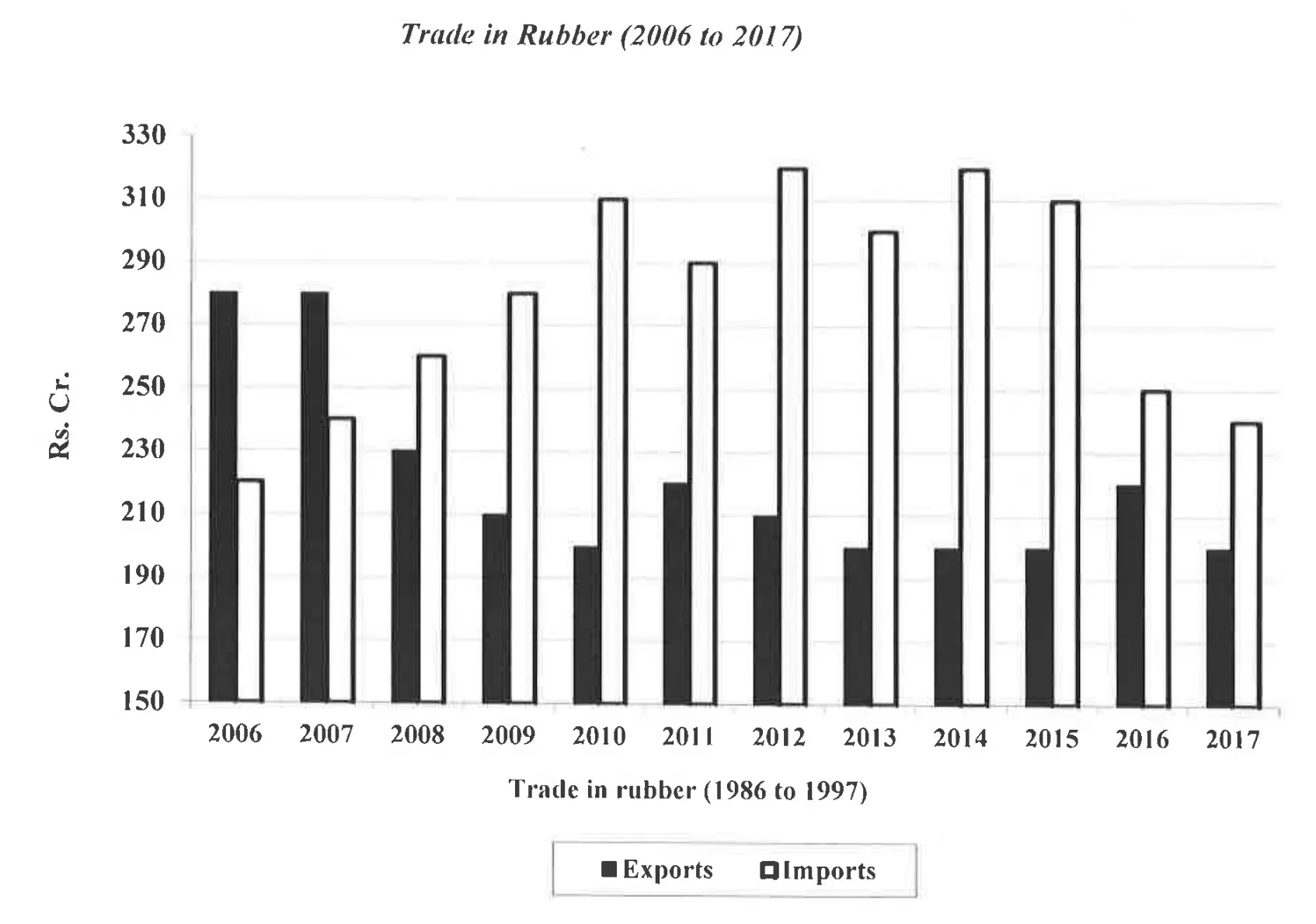
Analyze the given data for exports and imports of rubber in Rs. crores from 2006 to 2017 and answer the questions based on the analysis.
Average annual exports for the given period 2006-2017 was approximatelyquestion figure
  • ARs. 230 Cr
  • BRs. 220 Cr
  • CRs. 210 Cr
  • DRs. 190 Cr
Pick an option to attempt
Average=Sum of annual exports across all yearsNumber of years\text{Average} = \dfrac{\text{Sum of annual exports across all years}}{\text{Number of years}} =280+280+230+210+200+220+210+200+200+200+220+20012=\dfrac{280+280+230+210+200+220+210+200+200+200+220+200}{12} =265012220=\dfrac{2650}{12}\approx220 crores. Final Answer: Rs. 220 Cr
Q37:ipmat indore 2019LRDIBar GraphsEasyMCQ · MCQ
Analyze the given data for exports and imports of rubber in Rs. crores from 2006 to 2017 and answer the questions based on the analysis.
The percentage decline in exports during the period 2006-2011 is more than the percentage decline in exports during 2012-2017 by approximatelyquestion figure
  • A16.5
  • B20.5
  • C12.5
  • D21.5
Pick an option to attempt
Percentage decline during 2006-2011 period =Difference between 2006 and 2011 exports2006 exports×100=\frac{\text{Difference between 2006 and 2011 exports}}{\text{2006 exports}}\times100 =280220280×100=60280×100=approximately 21.42=\frac{280-220}{280}\times100=\frac{60}{280}\times100=\text{approximately }21.42% Now, percentage decline during 2012-2017 period will be calculated similarly. =210200210×100=10210×100=approximately 4.76=\frac{210-200}{210}\times100=\frac{10}{210}\times100=\text{approximately } 4.76% As we can see, the first percentage is more than the second by approximately 16.516.5, hence Option 1 is the answer. Final Answer: 16.5
Q38:ipmat indore 2019LRDIBar GraphsEasyMCQ · MCQ
Analyze the given data for exports and imports of rubber in Rs. crores from 2006 to 2017 and answer the questions based on the analysis.
The maximum difference between imports and exports isquestion figure
  • ARs. 60 Cr
  • BRs. 110 Cr
  • CRs. 120 Cr
  • DRs. 100 Cr
Pick an option to attempt
The phrase *difference between imports and exports* means the gap within a single year - the two bars standing side by side - so we compare year by year rather than picking the tallest bar from one year and the shortest from another. Reading the pairs off the chart and measuring the size of the gap between the two bars. Note that in 2006 and 2007 exports were the higher of the two, so the gap runs the other way in those years - what matters is how far apart the bars stand, not which is on top:
YearImportsExportsGap
200622028060
200724028040
200826023030
200928021070
2010310200110
201129022070
2012320210110
2013300200100
2014320200120
2015310200110
201625022030
201724020040
The largest gap is in 2014, where imports peak at Rs. 320 Cr while exports sit at their floor of Rs. 200 Cr: 320200=Rs. 120 Cr320 - 200 = \text{Rs. }120\text{ Cr} A shortcut is tempting here - take the tallest import bar anywhere (320, in 2012 and 2014) and subtract the shortest export bar anywhere (200, in 2010, 2013, 2014, 2015 and 2017). It gives the right number only because 2014 happens to hold both extremes at once. On a chart where the highest import and the lowest export fell in different years, that shortcut would compare two bars that never coexist and overstate the answer. Scanning the pairs is the reliable route. Final Answer: Rs. 120 Cr
Q39:ipmat indore 2019LRDIBar GraphsEasyMCQ · MCQ
Analyze the given data for exports and imports of rubber in Rs. crores from 2006 to 2017 and answer the questions based on the analysis.
Balance of trade is defined as imports subtracted from exports ( = exports - imports). Which of the following blocks of three years has witnessed the largest average negative balance of trade?question figure
  • A2007-2009
  • B2015-2017
  • C2014-2016
  • D2010-2012
Pick an option to attempt
For 2007-2009: 2007: 280240=40280 - 240 = 40 2008: 230260=30230 - 260 = -30 2009: 210280=70210 - 280 = -70 Average = 4030703=20\frac{40 - 30 - 70}{3} = -20 For 2015-2017: 2015: 200310=110200 - 310 = -110 2016: 220250=30220 - 250 = -30 2017: 200240=40200 - 240 = -40 Average = 11030403=60\frac{-110 - 30 - 40}{3} = -60 For 2014-2016: 2014: 200320=120200 - 320 = -120 2015: 200310=110200 - 310 = -110 2016: 220250=30220 - 250 = -30 Average = 120110303=86.67\frac{-120 - 110 - 30}{3} = -86.67 For 2010-2012: 2010: 200310=110200 - 310 = -110 2011: 220290=70220 - 290 = -70 2012: 210320=110210 - 320 = -110 Average = 110701103=96.67\frac{-110 - 70 - 110}{3} = -96.67 After comparing, the period 2010-2012 has the largest negative average balance of trade at 96.67-96.67 crores, making it the correct answer. Final Answer: 2010-2012
Q40:ipmat indore 2019LRDIBar GraphsEasyMCQ · MCQ
Analyze the given data for exports and imports of rubber in Rs. crores from 2006 to 2017 and answer the questions based on the analysis.
The percentage increase in imports over the previous year is maximum duringquestion figure
  • A2009 to 2010
  • B2010 to 2011
  • C2013 to 2014
  • D2008 to 2009
Pick an option to attempt
The percentage increase in imports for each given option using the formula: New Value - Original ValueOriginal Value×100\frac{\text{New Value - Original Value}}{\text{Original Value}} \times 100 2009 to 2010: Imports 2009: 280280 Imports 2010: 310310 Percentage increase = 310280280×100=30280×100=10.71%\frac{310 - 280}{280} \times 100 = \frac{30}{280} \times 100 = 10.71\% 2010 to 2011: Imports 2010: 310310 Imports 2011: 290290 This is a decrease: 290310310×100=6.45%\frac{290 - 310}{310} \times 100 = -6.45\% 2013 to 2014: Imports 2013: 300300 Imports 2014: 320320 Percentage increase = 320300300×100=20300×100=6.67%\frac{320 - 300}{300} \times 100 = \frac{20}{300} \times 100 = 6.67\% 2008 to 2009: Imports 2008: 260260 Imports 2009: 280280 Percentage increase = 280260260×100=20260×100=7.69%\frac{280 - 260}{260} \times 100 = \frac{20}{260} \times 100 = 7.69\% Comparing all values, the maximum percentage increase was 10.71%10.71\% during 2009 to 2010, making this the correct answer. Final Answer: 2009 to 2010

Other IPMAT Indore papers & sections